ZhongZe
China RotoMolds & OEM
Get a Quote
ZhongZe
China Roto
Rotational molding is widely used for manufacturing large hollow products such as chemical tanks, water storage containers, industrial equipment housings, and environmental solutions.
However, producing an ultra-large rotomolded chemical tank, such as a 5,000-liter capacity tank, requires advanced engineering knowledge, precise mold design, material expertise, and strict process control.
Unlike standard rotomolded products, large chemical tanks must meet higher requirements for structural strength, chemical resistance, wall thickness consistency, and long-term durability.
This article explains the key challenges and manufacturing solutions involved in producing large-scale rotomolded chemical storage tanks.
Large chemical tanks require significantly larger molds, production equipment, and handling systems.
Manufacturers must have:
The size and weight of the mold directly affect production difficulty and manufacturing stability.
For large tanks, achieving uniform wall thickness across a large surface area is one of the biggest technical challenges.
Uneven material distribution can result in:
Proper mold design, rotation speed adjustment, heating control, and material calculation are essential to achieve consistent wall thickness.
A 5,000L tank may need to withstand:
Material selection and structural design must be carefully optimized according to the application requirements.
Material selection plays a critical role in tank performance.
High-quality polyethylene materials are commonly used because of their:
For demanding applications, additional modifications may be required, such as:
The material formula must be optimized to maintain proper flow, melting behavior, and final product performance during rotational molding.
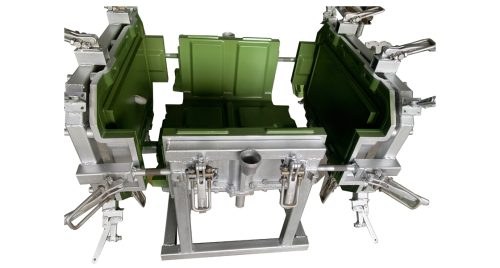
The mold is one of the most important factors affecting large tank quality.
Large tanks typically require:
Aluminum molds are widely preferred because they provide excellent heat transfer performance and dimensional stability.
For large products, temperature control across the entire mold surface is critical.
A well-designed mold should support:
Improper thermal control may lead to uneven melting, internal stress, or deformation.
Large tank production requires precise process management.
Key process factors include:
Controlled heating allows plastic powder to:
This helps prevent defects such as air bubbles, incomplete fusion, and weak areas.
The rotation ratio between the primary and secondary axes must be carefully adjusted.
Proper rotation ensures that material reaches:
Cooling is equally important as heating.
A controlled cooling process helps:
For large tanks, gradual cooling is often required to achieve stable mechanical performance.
Large chemical tanks often require additional structural optimization.
Common solutions include:
Special rib designs or reinforced geometries can improve:
This allows stronger tanks without excessive material increase.
For applications requiring temperature control, additional insulation layers may be added to improve thermal performance.
Large industrial tanks require strict quality verification.
Typical inspection includes:
Ultrasonic inspection can verify thickness consistency across different areas.
Testing ensures:
Overall dimensions, roundness, and connection areas should be checked according to project requirements.
Material performance may be evaluated for:
Producing a 5,000L rotomolded chemical tank is not simply a molding process. It requires integrated expertise in:
Successful large-scale rotomolding projects depend on the combination of advanced equipment, experienced engineers, and reliable manufacturing processes.
For companies seeking customized large plastic tanks, choosing a manufacturer with both rotomolding mold development capability and OEM production experience is essential to achieving consistent quality and long-term performance.
Explore our mold development and OEM manufacturing capabilities.
Need a custom mold, OEM production, or an electric kart boat? Share your project details with us. Our team will review your requirements and get back to you promptly.
No drawings yet? We can help review your idea and recommend the right approach.